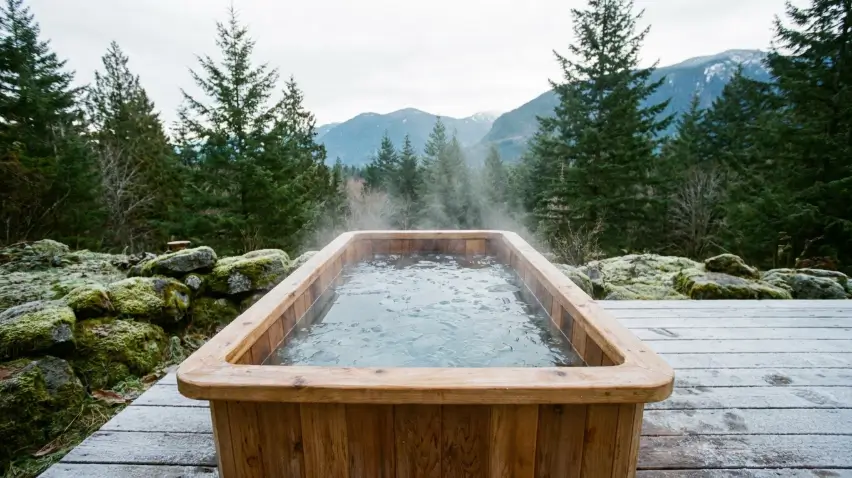
Routine cleaning for a wood-lined cold plunge runs roughly $15 to $40 a month for sanitizer, test strips, and filter cartridges, well below the several hundred dollars a neglected wood surface can cost to refinish later. The key cost decision is choosing wood-safe sanitizer over harsh, pool-strength chlorine products, which are cheaper up front but can dry out or discolor wood surfaces over repeated use. In a small, less-ventilated space, add a modest line item for humidity control, since trapped moisture around the tub is one of the faster ways wood surfaces develop mildew in a garage bay or closet-sized nook.
What Does Basic Monthly Cleaning Actually Cost?
For a two-person tub, expect to spend $15 to $40 a month on consumables: a bottle of wood-safe sanitizer, a set of water test strips, and a periodic cartridge filter swap. That range depends heavily on use frequency, since a daily-use setup burns through sanitizer and filter capacity faster than one used a couple times a week. Test strips are the cheapest line item, often just a few cents per test, but they’re the piece owners most often skip, which tends to be a false economy since catching a water quality problem early is far cheaper than dealing with cloudy or smelly water after the fact.
Why Do Wood-Safe Products Cost More, and Is It Worth It?
Wood-safe sanitizers formulated specifically for wood-lined tubs typically cost more per bottle than generic pool chemicals, sometimes noticeably so. The reason is concentration and formulation: standard pool-strength chlorine is built for large volumes of water and can be too harsh for direct, repeated contact with wood, drying it out or leaving discoloration over months of use. The added cost of a wood-safe product, often just a few extra dollars a month compared to generic chemicals, is small next to what it protects against, since wood damage from harsh chemicals tends to show up gradually and isn’t always covered under a standard warranty once it’s identified as chemical damage rather than a manufacturing defect.
What Does Filtration and Water Changes Add to the Ongoing Cost?
Cartridge filters for a compact setup commonly run $15 to $30 each and need replacing every few weeks to a couple months depending on use frequency and how well the water is maintained between changes. A full water change, water plus the electricity to bring a chiller back down to temperature, adds a modest but real cost every few months for lightly used tubs, more often for daily-use setups in a small, less-ventilated space where organic buildup from skin and sweat accumulates faster relative to the smaller water volume a two-person tub holds. Budgeting for filtration and periodic changes as a recurring line item, rather than an occasional surprise expense, keeps the real ongoing cost of ownership realistic from the start.
What Does Neglecting Wood Care Cost Later?
This is where the cost math tips heavily toward routine maintenance. Refinishing or resealing a wood surface that’s been exposed to harsh chemicals or chronic humidity commonly runs several hundred dollars, and in more severe cases, staves that have delaminated or begun to rot may need partial replacement, a cost considerably higher than any amount of wood-safe sanitizer would have added over the same period. For a small-space install where the tub sits closer to walls and stored items than it would in an open yard, splashed harsh chemicals or unmanaged humidity can also affect nearby surfaces, adding cleanup or repair costs that a well-ventilated, properly cleaned setup avoids entirely.
Do Small, Enclosed Spaces Add Extra Cleaning Costs?
Somewhat, yes. A tub in an open backyard gets natural airflow that helps surfaces dry between uses, while one tucked into a garage bay or closet-sized nook can trap humidity that promotes mildew on both the tub and nearby walls. A modest dehumidifier, often $150 to $300 for a small unit sized to the space, is a reasonable added cost for a small, enclosed install, and it pays for itself by reducing how often wood surfaces need attention beyond routine sanitizer and wipe-downs. Buyers comparing total cost of ownership for a compact tub, not just the sticker price, before choosing a small-space spot can explore the range of two-person models to compare shell material and maintenance requirements before deciding what fits both the budget and the room.
Is a Maintenance Service Worth It Compared to DIY Cleaning?
A professional maintenance service, where one exists locally for cold plunge tubs, typically charges $40 to $100 per visit for water testing, sanitizer dosing, and a general inspection, usually scheduled monthly. Against the $15 to $40 a month a DIY routine costs in supplies, a service adds a meaningful premium, one that mostly buys convenience and a second set of eyes rather than better cleaning outcomes for an attentive owner. For a small-space install specifically, a service visit can also flag humidity or ventilation issues around the tub before they become wood damage, which is a genuine value if the space is prone to trapping moisture and the owner isn’t checking it closely themselves.
Most owners land somewhere in between: DIY the routine sanitizer and filter checks, since they take only a few minutes a week, and call in a professional occasionally, maybe twice a year, for a deeper inspection of the wood surface, fittings, and drain. That hybrid approach keeps the monthly cost close to the DIY range while still catching problems a purely hands-off owner might miss, which matters more in a tight, enclosed footprint where small issues like a slow drip or a patch of mildew behind the tub can go unnoticed longer than they would in an open, frequently walked-past backyard spot.
Frequently Asked Questions
What does routine cold plunge cleaning cost per month?
Sanitizer, test strips, and filter changes typically run $15 to $40 a month for a two-person tub, depending on use frequency.
Can regular pool chemicals damage a wood-lined cold plunge?
Yes, high-concentration chlorine formulated for pools can dry out or discolor wood surfaces over repeated use. Wood-safe sanitizers are the safer choice.
How often should the water be fully changed in a small setup?
Every few months for lightly used tubs, more often for daily-use setups where organic buildup happens faster.
What does neglecting wood care eventually cost?
Refinishing commonly costs several hundred dollars, and severe cases can require partial stave replacement, well above routine maintenance costs.
Does a small, enclosed space increase cleaning costs?
Somewhat, since trapped humidity can promote mildew, sometimes requiring an added dehumidifier or more frequent wipe-downs.
References
- “Effects of cold-water immersion on health and wellbeing: A systematic review and meta-analysis.” PLoS One, 2025. https://pubmed.ncbi.nlm.nih.gov/39879231/
- “Effects of cold water immersion after exercise on fatigue recovery and exercise performance: meta analysis.” Frontiers in Physiology, 2023. https://pubmed.ncbi.nlm.nih.gov/36744038/
- “Cold-water immersion (cryotherapy) for preventing and treating muscle soreness after exercise.” Cochrane Database of Systematic Reviews, 2012. https://pubmed.ncbi.nlm.nih.gov/22336838/
By Naomi Solheim